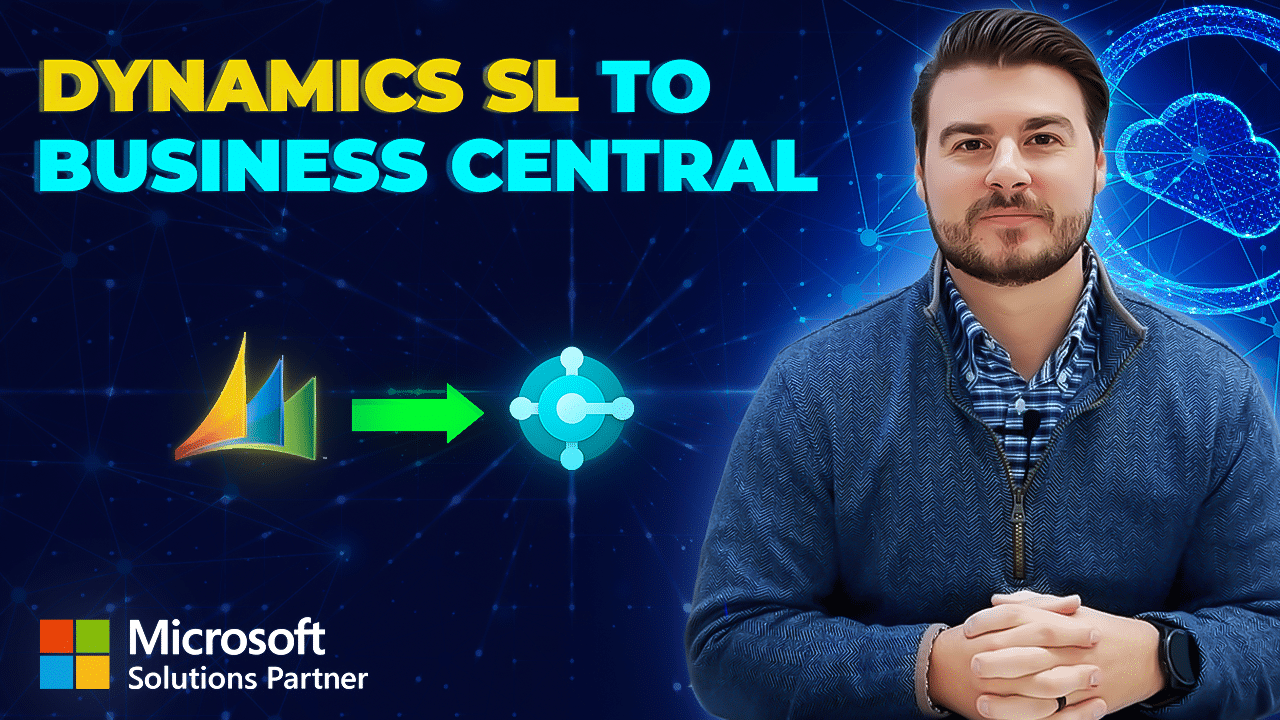
For those customers that are running on Dynamics SL, you're probably wondering how you're gonna navigate this upgrade to the cloud with Dynamics three sixty five Business Central. Well, I'm here to help you navigate that today, and I wanna highlight some of the three main differences that I would wanna be made aware of if I was a customer currently running Dynamics SL and trying to understand the upgrade process. The first main difference between SL and Business Central is specific to the capabilities that each ERP is able to perform. SL is extremely robust ERP application that covers all financial sales, purchasing, inventory. But it has a very specialized capability in project management and for specifically professional services industries. Business Central, while it does have the project management module, formerly the jobs module, it does not have the in-depth capabilities that you're going to see in regards to what SL has today. Microsoft has added a lot of capabilities and continues to invest in Business Central's project management module, but it's not to the extent that is currently in place today with SL. But with that said, there are many more generalized capabilities available in Dynamics three sixty five Business Central as compared to what you get with Dynamics SL today. So across financials, sales, purchasing and inventory, you're going to see a lot more capabilities, but maybe eighty to ninety percent of the capabilities that you have in the SL product or project management specifically. So that would be the number one thing, the first thing that I would want to be made aware of in regards to the differences between the two products. The second thing is going to be on the actual deployment itself. With SL, you are in an on premise environment where everything is maintained on that specific server. And in the cloud with Dynamics three sixty five Business Central, you no longer are having to run that on premise server to support that application. Comes with a lot of pros and cons. So on the pros, you now are able to scale kind of indefinitely. So be able to scale up and scale down depending on what the needs are of your business within the cloud. But then the con is that you don't have as much control over that scaling, whereas in the on prem environment, you could extend or add additional servers to be able to have additional compute workload. But within the cloud, that's kind of on Microsoft's ownership to be able to scale up and scale down as they see the needs from the backend or the telemetry signals that are given off. And then the third thing comes down to the licensing. So with SL, you're purchasing an upfront fixed fee on premise perpetual license. But then in the cloud, you're moving more towards a seat license. And it is performed on really a monthly basis. And it's more of a leasing type of licensing structure, if you will, as opposed to purchasing it all upfront and having that higher cost incurred upfront. So those are the three main differences that I always like to educate our customers that are looking to go through an upgrade from Dynamics SL into Dynamics three sixty five Business Central, just laying out all of the honest truths about it, being transparent. If you'd love to hear more about what the differences are between the products, there's of course many other differences that we can help guide you all on. Please reach out to one of our team members and we'll be sure to get in touch with you or leave a comment below. Looking forward to talking with you.
Upgrade from Dynamics SL to Business Central: 3 Key Considerations for Your ERP Migration https://volt-technologies.com/contact/ For organizations currently operating on Microsoft Dynamics SL, this comprehensive analysis examines the essential factors to consider when planning your cloud migration to Dynamics 365 Business Central:
- Project Management Capabilities: Discover how Business Central’s project management module compares to SL’s specialized functionality and what this means for your operations
- Deployment Differences: Learn about the shift from on-premise servers to cloud-based infrastructure and how this affects scaling, control, and maintenance
- Licensing Structure Changes: Understand the financial implications of moving from perpetual licensing to a monthly subscription model
As cloud technology continues to advance, staying informed about your ERP modernization options is essential for maintaining operational efficiency and competitive positioning.
